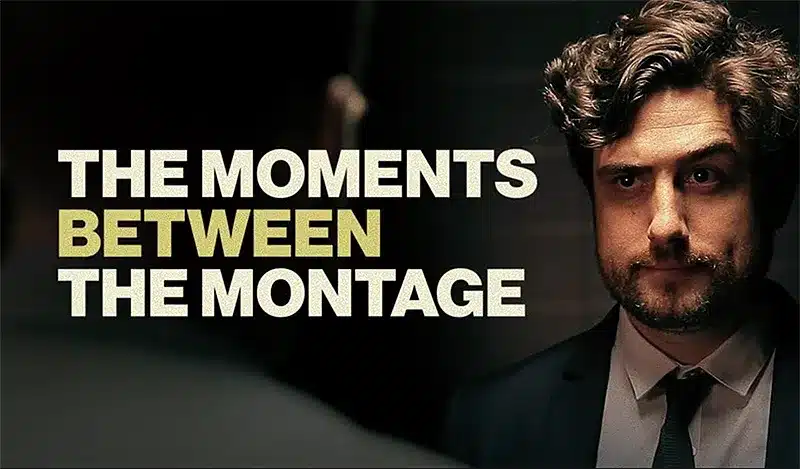
The YouTube channel Chris and Jack produces comedic video sketches that frequently begin with recognizable pop-cultural clichés and gradually push them beyond their conventional logic. The channel does not follow a consistent release rhythm, but each video is structured around the deconstruction of familiar cultural conventions.
In “A vital message from your future self”, a man named Chris travels from the future to reassure his past self that everything will turn out well, offering no warning or directive to change course. This absence of narrative expectation destabilizes his past self’s decision-making, turning even mundane choices—such as what to eat for lunch—into potentially consequential acts.
In “A deal with the Devil”, the devil offers one to sell his soul to become a great guitar player, and the offer is immediately rejected. So, the devil tries to negotiate for parts of the soul. Is that even possible? The answer remains no; the devil is reduced to the logic of an overly persistent salesperson.
In an online environment built around personality and constant self-exposure, Chris W. Smith and Jack De Sen’s work remains strikingly centered on the sketch itself. It’s simply that their cultural contribution works best if the creators remain secondary to the formal logic of the sketches themselves. The videos are, of course, funny and entertaining, but their comedy also functions as a form of media criticism. They work with the building blocks of collective cultural memory to expose the exhaustion of familiar narrative tropes.
This structure repeats throughout the channel. One guy is having a Groundhog Day (“Groundhog Daying”) because that is already a cliché. In “Your Whole Life is a TV Show”, Jack learns that his life is a TV show, and it was just canceled because it was so boring. In “I Need It Yesterday”, a boss says he wants a report “Yesterday,” which is taken literally, eventually forcing an employee to invent time travel.
“After the heist” opens with a group of thieves that just pulled off a big heist, but what’s missing, and what bothers them, is that they don’t have that kind of scene at the end of the heist movie that serves as an epilogue for viewers and, as it seems, emotional closure for the character. When a group of fantasy heroes in “We meet at first light!” goes on a fantastic journey to save their realm, going “in the break of dawn” becomes a task of understanding how to wake up, how to find the place, and whether they should have eggs for breakfast. Similar structural reversals appear throughout Chris and Jack.
Some might argue that, since Jacques Derrida and the Yale school, we are all living in a state of cultural deconstruction. One might also say that spoof movies from the 1980s, likeAirplane!andTop Secret!, dismantle genre conventions, deconstruct popular culture, and expose the artificiality of familiar narrative forms. While Chris and Jack clearly participates in that broader tradition, the sketches also rely on a more specific contemporary media condition.
The effectiveness of these videos, and the clichés they address, depends on viewers recognizing how clichéd they are and linking them to the sketch, which has no prelude or prologue and exists only within the short video format.This is partly a critique of the repetition and narrative exhaustion that characterize most modern audiovisual production, whether made by big studios or individual YouTubers filming at home. Still, it goes beyond that. It also criticizes our own consciousness, which has become conditioned to expect a specific outcome in any given situation.

Indeed, the Chris and Jack sketches point toward a broader media condition concerning the roles of television, film, and YouTube videos in today’s society. The clichés addressed in the videos are so widespread and deeply ingrained that they need neither introduction nor further explanation: a single scene is enough for viewers to instantly understand what came before, each character’s role, and what we’re expected to anticipate. Because of this, the subversion of these expectations becomes all the more powerful—we’ve seen this scene countless times before. We expect viewers to supply the missing narrative structure themselves.
Eventually, this culminates in a critique of the culture they are part of. In one particularly self-referential video, “CONTINUITY ERRORS”, continuity errors occur in real life: it shows Chris and Jack editing a video while editing a video. They get to doubt who they are and what reality is, because cliches are part of our reality now. The distinction between reality and representation begins to collapse.
In “Movies in space”, an astronaut from Earth (Chris) travels to another planet where all movies are just a series of blinking screens in different colors. The premise becomes increasingly absurd once he is absorbed into that planet’s entertainment industry, becoming the, well, cliché of a wealthy person who comes to be a director-producer-star consumed by glory and drugs for this, obviously, ridiculous society. His character says, “all movies are the same”, which is, actually, the point of the sketch.
Like many science fiction creations, that’s a commentary society: all movies are essentially blinking screens with changing colors, and, actually, that all movies are the same to one another too many times. Chris and Jack’s videos, too, like all videos and movies, are nothing but blinking screens with changing colors.
In Chris and Jack’s case, their videos of blinking screens with changing colors must always be entertaining, lest. In “I command you to make me sad”, King (Jack) asks Jester (Chris) to, well, you read the title. Jester tries and tries, and even when he says that maybe people are just nice to King because he is the king, King does not agree. Only when Jester drops a ball while juggling does King get sad; he doesn’t like it and immediately asks never to experience it again. Jester says, “You got it.” Because what will a content creator do but entertain? Should Chris and Jack drop the ball, the crowd will “behead” their series by turning away, letting the series drop like, well, a beheaded head.
That tension to keep up the entertainment may explain the tone of Chris and Jack. Much of the channel’s effect depends on how completely the characters disappear into the structure of the sketches themselves, so as not to dilute their message with the characters’ personalities. It would involve irrelevant aspects in their ongoing cycle of self-referential media production. Much of their comedy depends on revealing how overdetermined these conventions have become. Yet the videos must remain entertaining to function within the attention economy they implicitly critique.
Chris and Jack must create more videos, more blinking screens with changing colors. The creators increasingly appear inseparable from the mediated worlds their sketches construct. That absence of external framing gives the sketches an unusually closed and self-contained quality. Their videos acknowledge that all movies, hence, all videos are nothing but a series of blinking screens with changing colors.
Chris W. Smith and Jack De Sen and their characters and their creators live “within”, if you will, their videos about continuity errors. We may be on the outside looking in on Chris and Jack, but we, too, are caught in an endless repetition of blinking screens with changing colors, embedded within the very structures we attempt to describe.