
On Monday December 8th the Oxford University Press Journal SLEEP Advances made a startling claim: that, as one headline put it, getting less than seven hours of sleep is linked to shorter life expectancy.
In other words, get less than seven hours of sleep per night and you shorten your life.
Which means that getting between seven and nine hours of sleep on a regular basis can lengthen your life.

Put that new information together with older scientific studies and you come to a simple but awe-injecting conclusion: getting into the habit of a good night’s sleep, a sleep of seven to nine hours, can help add up to 24 years to your life. Yes, 24 years!
Enough years to watch your child go from birth to adulthood. In other words, enough years to constitute an extra lifetime.
But back to Monday’s study. This amazing work on sleep and your life expectancy was done by eight researchers at the Oregon Health & Science University in Portland, Oregon. Their SLEEP Advances article had the awkward and slippery title ““Sleep insufficiency and life expectancy at the state-county level in the United States, 2019-2025.”
The study analyzed data from the Centers for Disease Control and Prevention’s Behavioral Risk Factor Surveillance System, a data and telephone survey of close to three million ordinary people in 3,000 counties from coast to coast over six years, including a monthly telephone poll in which the CDC pollsters asked a simple question: “On average, how many hours of sleep do you get in a 24-hour period?”
The Oregon Health & Science researchers came to a seemingly sideways conclusion.
To quote the article, “Insufficient sleep was significantly negatively correlated with life expectancy in most states from 2019–2025, such that lower sleep insufficiency was associated with longer life expectancy.”
What in the world does that mean?

The people of some counties slept longer hours than the residents of others. And, guess what? The folks in counties where the amount of sleep was longer lived the longest. In fact, of the factors accounting for a shorter life, smoking came out as the greatest life stopper. But sleeping less than seven hours a night came out second.
In fact, sleeping less than seven hours a night was a greater killer than diabetes, physical inactivity, food insecurity, lack of health insurance, unemployment, not completing high school, and a lack of friends and family.
But there’s a positive implication you and I can pull from this. There’s a prescription for a startlingly longer life. A life up to 24 years longer.

There have been a total of over 12,000 studies on sleep and the number of years you will live. One indicates that sleeping at regular hours every night can ratchet up the number of years you live. Dramatically.
This study was presented by a researcher from the Veterans Affairs Administration at the American Society for Nutrition’s annual conference in July, 2023. It said that folks who not only got a good night’s sleep, but who had adopted seven other healthy habits before they hit the age of forty could expect to live 24 years longer if they were men and 21 years longer if they were women.
What were the eight healthy habits that could add decades to your life?
- Getting regular exercise.
- Eating a balanced diet.
- No opioids.
- No smoking.
- Limiting your alcohol.
- Limiting stress.
- Maintaining your social relationships.
- And, guess what? Sleeping seven to nine hours a night.
Said the senior author of the Oregon Health University study, Andrew W. McHill Ph.D., ”I didn’t expect” sleep “to be so strongly correlated to life expectancy. We’ve always thought sleep is important, but this research really drives that point home: People really should strive to get seven to nine hours of sleep if at all possible.”
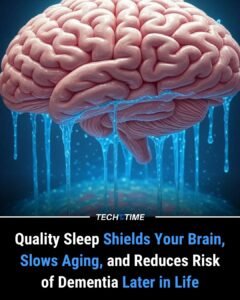
In other words, if you want a long life, sleep is your ultimate life-hack. Sleep is your ultimate weapon in the battle against death.
______
About the author: Howard Bloom of the Howard Bloom Institute has been called the Einstein, Newton, Darwin, and Freud of the 21st century by Britain’s Channel 4 TV. Bloom’s new book is The Case of the Sexual Cosmos: Everything You Know About Nature is Wrong. Says Harvard’s Ellen Langer of The Case of the Sexual Cosmos, Bloom “argues that we are not savaging the earth as some would have it, but instead are growing the cosmos. A fascinating read.” One of Bloom’s eight previous books–Global Brain—was the subject of a symposium thrown by the Office of the Secretary of Defense including representatives from the State Department, the Energy Department, DARPA, IBM, and MIT. Bloom’s work has been published in The Washington Post, The Wall Street Journal, Wired, Psychology Today, and the Scientific American. Not to mention in scientific journals like Biosystems, New Ideas in Psychology, and PhysicaPlus. Says Joseph Chilton Pearce, author of Evolution’s End and The Crack in the Cosmic Egg, “I have finished Howard Bloom’s [first two] books, The Lucifer Principle and Global Brain, in that order, and am seriously awed, near overwhelmed by the magnitude of what he has done. I never expected to see, in any form, from any sector, such an accomplishment. I doubt there is a stronger intellect than Bloom’s on the planet.” For more, see http://howardbloom.net or http://howardbloom.institute
Resources:
Kathryn E. McAuliffe, Madeline R. Wary, Gemma V. Pleas, Kiziah E.S. Pugmire, Courtney Lysiak, Nathan F. Dieckmann, Brooke M. Shafer, and Andrew W. McHill, all affiliated with Oregon Health & Science University. “Sleep insufficiency and life expectancy at the state-county level in the United States, 2019-2025,” published December 8, 2025 in SLEEP Advances (Oxford University Press). DOI: 10.1093/sleepadvances/zpaf090
Nguyen, Xuan-Mai T. “Impact of Healthy Lifestyle Factors on Life Expectancy in US Veterans: Findings from the Million Veteran Program (MVP).” Abstract presented at Nutrition 2023, Boston, MA, July 24, 2023. American Society for Nutrition, https://nutrition2023.eventscribe.net/index.asp?presTarget=2435709
Welsh, Jennifer. “Good Sleep Linked to Longer Life.” Sleep Foundation. Last modified August 10, 2023. Accessed December 11, 2025.https://www.sleepfoundation.org/sleep-news/good-sleep-linked-to-longer-life.
American College of Cardiology. “Getting Good Sleep Could Add Years to Your Life.” Press release, February 23, 2023. https://www.acc.org/About-ACC/Press-Releases/2023/02/22/21/35/Getting-Good-Sleep-Could-Add-Years-to-Your-Life.
Knutson, Kristen L., et al. “Role of Sleep Duration and Quality in the Risk and Severity of Type 2 Diabetes Mellitus.” Archives of Internal Medicine 166, no. 16 (September 18, 2006): 1768.
Gottlieb, Daniel J., et al. “Association of Sleep Time with Diabetes Mellitus and Impaired Glucose Tolerance.” Archives of Internal Medicine 165, no. 8 (April 25, 2005): 863.
Nilsson, Peter M., et al. “Incidence of Diabetes in Middle-Aged Men Is Related to Sleep Disturbances.” Diabetes Care 27, no. 10 (2004): 2464.
King, Carolyn R., et al. “Short Sleep Duration and Incident Coronary Artery Calcification.” JAMA 300, no. 24 (2008): 2859–2866.
Opp, Mark R., et al. “Neural-Immune Interactions in the Regulation of Sleep.” Frontiers in Bioscience 8 (May 1, 2003): d768–79.
Cohen, Sheldon, et al. “Sleep Habits and Susceptibility to the Common Cold.” Archives of Internal Medicine 169, no. 1 (January 12, 2009): 62–67.
Colten, Harvey R., and Bruce M. Altevogt, eds. Sleep Disorders and Sleep Deprivation: An Unmet Public Health Problem. Washington, D.C.: National Academies Press, 2006.
Spiegel, Karine, et al. “Brief Communication: Sleep Curtailment in Healthy Young Men Is Associated with Decreased Leptin Levels, Elevated Ghrelin Levels, and Increased Hunger and Appetite.” Annals of Internal Medicine 141, no. 11 (December 7, 2004): 846–850.
Spiegel, Karine, et al. “Impact of Sleep Debt on Metabolic and Endocrine Function.” Lancet 354, no. 9188 (October 23, 1999): 1435–1439.
Meier-Ewert, Heidrun K., et al. “Effect of Sleep Loss on C-reactive Protein, an Inflammatory Marker of Cardiovascular Risk.” Journal of the American College of Cardiology 43, no. 4 (February 18, 2004): 678–683.