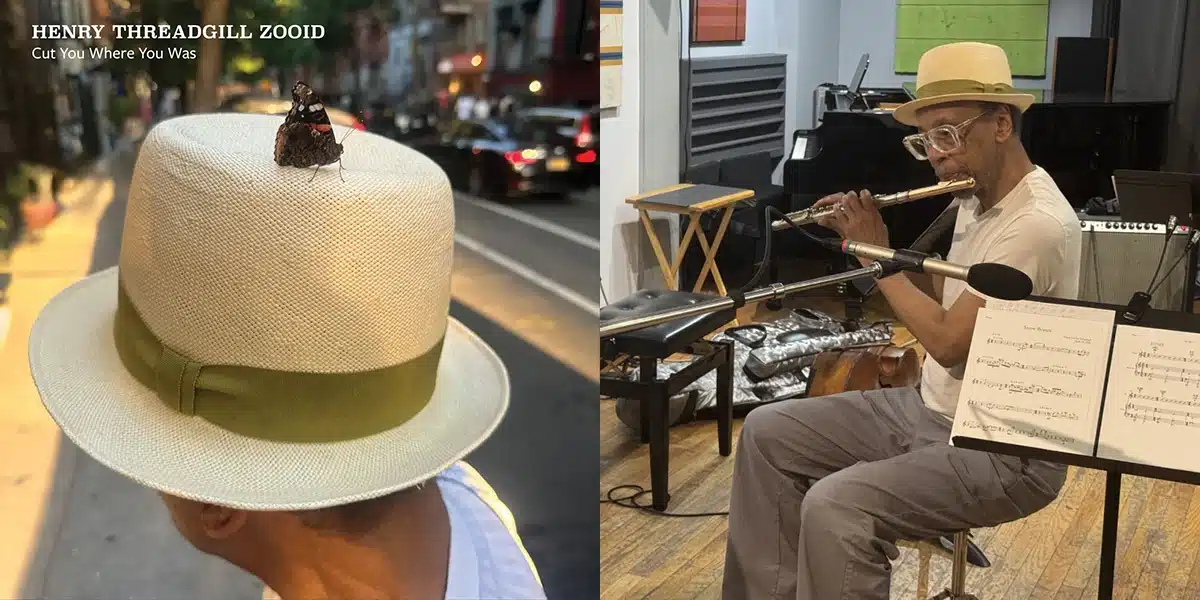
The astonishing career of composer, saxophonist, and flautist Henry Threadgill seems as strong and distinctive as ever in 2026. Just weeks ago, he released his first recording on Nonesuch Records with co-leaders Vijay Iyer and Dafnis Prieto (both MacArthur Fellows), and now his longstanding band Zooid has put out Cut You Where You Was on the independent label Pi Recordings, which was created in significant part to keep Threadgill‘s music in our ears.
What a success the last quarter century has been, since Pi simultaneously released Everybodys Mouth’s a Book and Up Popped the Two Lips in 2001. The former was by a Threadgill band called Make a Move, which featured mallet percussion, electric guitar, eclectic bass, and drums around the leader’s woodwinds; the latter was the debut of a new band, Zooid, featuring acoustic guitar, tuba/trombone, cello, and drums. Zooid continued to work, releasing six additional albums through 2021. Here, the band returns with original members Liberty Ellman (guitar) and Jose Davila (low brass), as well as Christopher Hoffman’s cello and drummer Elliot Humberto Kavee.
Cut You Where You Was is classic Zooid, making it hard to categorize: playful, carefully constructed, improvised, abstract, and earthy. What makes this outing different is how many of the performances are extremely brief. Seven of the ten tracks come in around two minutes. As a result, Cut You Where You Was has a pointillistic quality. It offers tapas from Threadgill’s kitchen, with one main dish to start and a masterpiece of more than 12 minutes in the center.
The six-minute prelude, “Fluoroscope”, is a tricky place to start, I think. Several written lines overlap: one for alto saxophone and guitar, another for cello and trombone, each bopping around the other without Kavee or a “rhythm section” to create groove or tempo. The five players play a collective improvisation that incorporates written lines off and on. I don’t want to call the music dry or academic—it is too melodically playful to seem dull, flat, or harsh—but Threadgill tests our patience for a while. Ellman’s eventual solo over Davila’s tuba and Kavee’s drums finds delicious blues intervals and bends, reminding us that Threadgill’s roots are in Chicago.
“Bingo” follows, Parts 1-3: two miniatures showcasing Threadgill’s flute tones, then a slightly longer part that layers the instruments on top of each other in guided improvisation. The flute pieces sound more like a soloist over an accompanying band, perhaps because Threadgill’s flute carries more sonic distinction from the other instruments. “Part 2” is the standout, with Threadgill’s flute close to a microphone, sharp but airy, while Ellman’s gets a sharp, almost dobro-like sound from the guitar, and Hoffman and Davila find growls and ‘boings’ from trombone and cello.
What is most arresting, still, is the album centerpiece, “Red Admiral Red Moon Rising”. It begins as a small concerto for Hoffman’s cello, playing a new-music-style composed melody, punctuated by quick bursts from the band. When the group kick in with a bouncing, polyrhythmic groove, Hoffman lays into a joyous improvisation. He finishes it with a downward gliss that Threadgill matches on alto as he takes off soloing. The ensemble stays sharp and responsive throughout, then supports an Ellman guitar solo. It is almost as if you were listening to a “normal” jazz recording, as a composed head kicks in at the conclusion of the three solos. That head, however, is straight out of an Ornette Coleman acid trip, and wonderfully so.
The remaining five tracks are all brief sketches. Each is like a pocket new jazz symphony: plenty of improvising, woven through written parts like the beams of tiny rooms, planned to perfection. “Blur” builds a raggy cadence around a set of snare drum figures that lock in with the cello—Davila’s tuba solos, followed by a counterpoint improvisation for flute and guitar. “Off and On What Happened” also starts with a rhythmic feel, this time a martial drum feel from Kavee that locks in with a saxophone/guitar written figure, over which the trombone gets loose like Kid Ory.
In fact, it seems plain that Henry Threadgill intends to put listeners in the mind of recordings from the pre-LP small-band era with the combination of short durations and collective blowing. When Davila is playing tuba on the bottom or blowsy trombone on the top, Louis Armstrong‘s Hot Five records are in the breeze. A tune like “Snow Bones”, featuring flute and acoustic guitar in the forefront, could almost pass for a country blues recording from the 1920s, with a bit of the 1960s folk around the edges.
In the end, of course, this is very modern music by Henry Threadgill, not a direct nod to any one thing. Threadgill’s trio Air made an explicit recording of two Scott Joplin rags and two Jelly Roll Morton pieces in 1979 (Air Lore), so know that refracting that material through a sensibility of freedom is one of his interests. The short pieces on Cut You Where You Was are not as direct in their references to the tradition, but the intention seems intact. Henry Threadgill continues to extend the impulses and heritage of that early music, but without the obedience that marked the jazz neo-classicism of much of the acoustic jazz of the 1980s.
The sound, for example, on the last track of Cut You Where You Was is slightly exotic in how directly Afro-Cuban it sounds and untethered from European/Tin Pan Alley harmonies. Kavee clatters out a dancing pulse as Davila plays a descending tuba part. Hoffman’s cello and Ellman’s acoustic guitar are plucked a bit like kalimbas, but they also suggest Delta blues (or pre-blues?) guitars in finding notes between the cracks. Above it all, Henry Threadgill dances, playing melodies that will never quite conform.
By now, of course, this kind of music is simply Threadgill’s own language. For me, Cut You Where You Was isn’t at the very top of Zooid’s run of wonderful music in the new century, but I also take it as another refraction of that larger body of work. It is all a revelation.