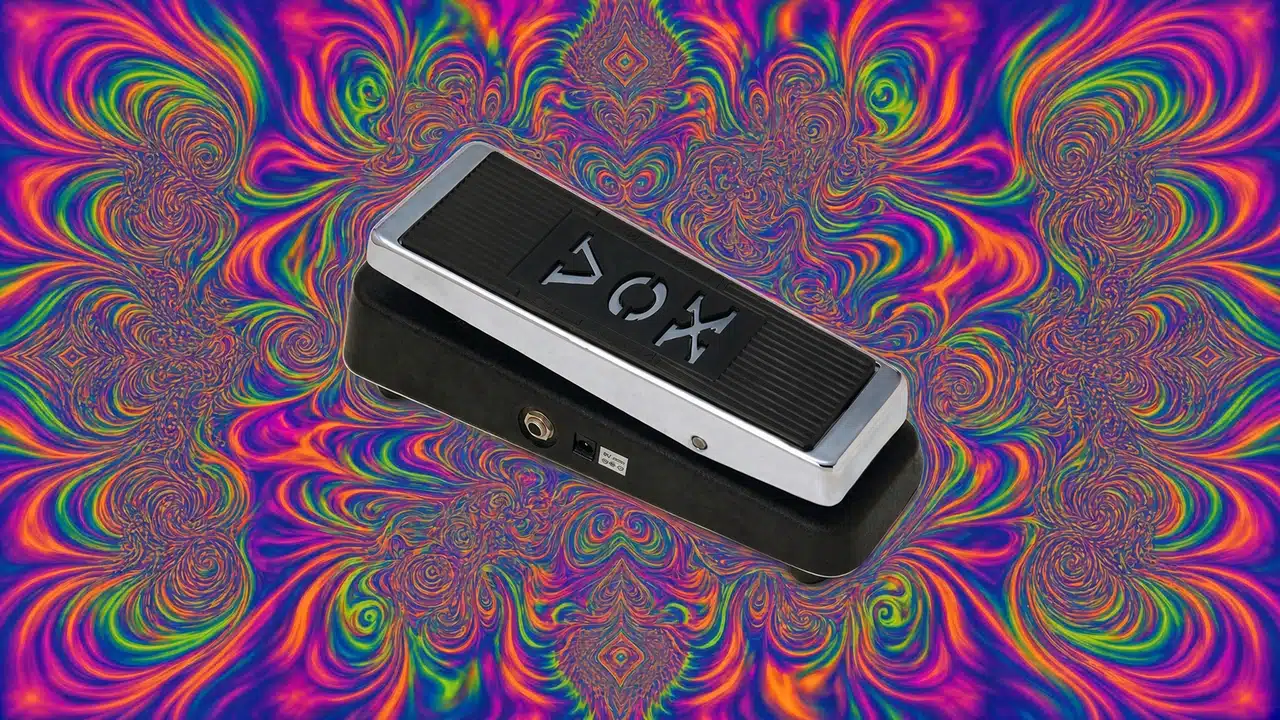
The wah-wah pedal. It’s the foot-stomping device guitarists used to add the signature spice, a taste of toe-tapping funk or cosmic psychedelic noodling, to a host of classics beginning in the 1960s. Isaac Hayes’ “Shaft”, Jimi Hendrix‘s “Voodoo Child”, Funkadelic’s “Maggot Brain”, Cream’s “White Room”, Chicago’s “25 or 6 to 4”, the Temptations’ “Papa Was a Rollin’ Stone”, Madrill’s “Fence Walk”, Rage Against the Machine‘s “Bulls on Parade”, and a dozen Red Hot Chili Peppers‘ offerings.
These songs would be far less memorable if they were stripped of the weeping blue notes and rhythmic punch, the earwormy sonic watermark that their wah-wah-wielding guitar slingers slathered onto the mix. As we will see in a moment, wah-wah wankery has not only been the purview of guitarists. Before we get into that, a little backstory on how the wah came to be.
Like many inventions, several can lay claim to helping create and commercialize the wah-wah pedal, but one thing is for sure. It wouldn’t have existed without Del Casher, a talented Los Angeles session guitarist who had the distinction of playing with both Lawrence Welk and Frank Zappa.
In addition to his busy playing schedule, Casher was a demonstration artist for Vox, the makers of popular amplifiers and organs. One day in 1966, he heard an engineer named Brad Plunkett fiddling with an amp’s control knob in the company lab. As he twisted it back and forth, it emitted a “wah-wah” sound. It was very much like the crying sound that came when a trumpet was played with a plunger mute, as on King Oliver’s “Dippermouth Blues” and Duke Ellington‘s “East St. Louis Toodle-oo.” Casher suggested that Plunkett insert the knob into one of the volume pedals that Vox used on its organs, allowing him to manipulate it with his foot. And, eureka, the wah-wah pedal was born.
Casher quickly began using it in sessions, and within short order, his former bandmate, Frank Zappa, also used it. Zappa reportedly introduced it to Jimi Hendrix after a gig in New York’s Greenwich Village. Through Hendrix and Eric Clapton, it rapidly became a must-have for every guitarist. As guitar pedal boards have expanded to gargantuan lengths in the past few decades, it’s sure to be among any sonically minded player’s arsenal today. In the experimentally minded 1960s, guitarists weren’t the only ones getting it on with wah-wah stomping.
In his once-maligned but now-acclaimed fusion bands of the early 1970s, Miles Davis frequently used the pedal to shape his tone on albums including Live Evil, On the Corner, and Agartha. Another trumpeter, Randy Brecker, began using it when the guitarist in his proto-fusion band Dreams, John Abercrombie, didn’t show up for a rehearsal one day, and Brecker copped the device. Brecker used it to great effect on albums by another great early fusion band, the Eleventh House.
In my opinion, the wah-wah’s tastiest use outside the guitar world came from saxophonists. The sax wah-wah work that rock music fans may know best came from Traffic’s Chris Wood.
Perhaps following the lead of jazzman Eddie Harris, whose groundbreaking 1967 album, The Electrifying Eddie Harris, set a precedent, Wood plugged in and began using various devices. These included the Varitone System (which could produce sub-octaves, echo, and tremolo effects) along with the wah-wah. Wood’s wah-wah is the centerpiece of “Glad”, the opening track on Traffic’s 1970 album, John Barleycorn Must Die. Wood also employed the device tastefully in solos on tracks like “Low Spark of High Heeled Boys” and in his composition, “Tragic Magic”. For more on this underappreciated musician, go out and find Dan Ropek’s wonderful 2015 biography, Tragic Magic: The Life of Chris Wood.
Naturally, Zappa’s reed men, Bunk Gardner and Ian Underwood, were in on the action. They slathered both Varitone and wah effects on several selections from Zappa’s Uncle Meat, including “Dog Breath Variations.” It’s Underwood wanking the wah, sounding like an angry goose (that’s a good thing!) on the title track of Zappa’s album, Chunga’s Revenge.
However, the true masterclass in wah-wah on sax goes to the great King Curtis on his 1971 album, Live at the Fillmore West. Curtis was one of music’s greatest saxophonists, the man whose work you hear on everything from the Coasters’ “Yakety Yak” and Aretha Franklin’s “Respect” to his own hits, “Memphis Soul Stew” and “Soul Serenade.” His band and his super-funky performances on his live Fillmore album are the apex.
Curtis’ backing band, the Kingpins, featured four of the era’s greatest musicians: drummer Bernard “Pretty” Purdie, guitarist Cornell Dupree, bassist Jerry Jemmot, and Billy Preston on the organ. Add to this the backing horn section featuring the legendary Memphis Horns.
Curtis wails with wah-wah on other tunes on the album, including a cover of “Ode to Billie Joe,” but none finer than on “I Stand Accused”. The latter was written and first recorded by the great soul singer Jerry “The Ice Man” Butler and later became a huge hit for Issac Hayes. Curtis slams across this slow groove after a long, spoken-word introduction.
This album also features incredible covers of Procol Harum’s “Whiter Shade of Pale” and Zep’s “Whole Lotta Love.” On this bill, Curtis and his band backed Aretha Franklin, who released her own live album from recordings made at this legendary venue.
If you dig into this, there’s more to seek out. Some of saxophonist Steve Mackay’s proto-punk sax with Iggy and the Stooges features wah-wah, as does David Sanborn’s work with David Bowie on the album Young Americans. Morphine’s Dana Colley also stomped on one on occasion, and the inhumanly talented Michael Brecker dabbled with it on the live version of “Funky Sea, Funky Dew”.
One legend who reportedly dismissed the wah-wah at first was James Brown. When Del Casher showed it to him shortly after its creation, the Godfather of Soul called it “pointless” and “wouldn’t be cool”. By 1974, it seems he changed his tune – somewhat. That year’s big single, “Funky President,” is driven by a wah-wah… on the guitar. For James, it seems to have been limited to this initial instrument.