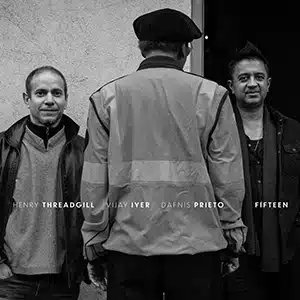

Fifteen
Henry Threadgill, Vijay Iyer, and Dafnis Prieto
Nonesuch
21 August 2026
This trio of alto saxophonist and flautist Henry Threadgill, pianist Vijay Iyer, and drummer Dafnis Prieto has been an occasional working band for 15 years. However, they make their debut with this crisp and still adventurous album. Each member is a distinctive composer and listener, making Fifteen a recording of sympathy and design.
Threadgill is one of jazz’s leading composers and bandleaders today, a Pulitzer Prize winner, a product of Chicago’s Association for the Advancement of Creative Musicians, and an important mentor to many musicians in the vanguard of contemporary creative music. Iyer, a generation younger, is nevertheless a key figure in the same scene, working in many different contexts as a bandleader and academic. He is a MacArthur Fellow and an alumnus of Steve Coleman’s bands, as is Cuban Prieto. The band are heavy, but the music isn’t.
In fact, the greatest pleasure of Fifteen is hearing each of these musicians interact on a clean, open field of sound. Threadgill, in particular, has been working mainly with his own bands for, seemingly, ever, and increasingly acts only as composer and bandleader. This band allow him to play simply, for example, on Iyer‘s blues/funk groover “I Wanted a Map”, using the kind of gruff alto sound you might have once heard from him in Chicago. Similarly, Prieto’s “On the Way” asks the saxophonist to play a spare theme and improvise over a cooking array of determined harmonies. Threadgill sounds like no one else,yetalsorefreshingly different from his own albums.
The three Threadgill compositions, conversely, are given a wonderful reading by the openness of this small group. “Trio Piece” boasts a characteristically angular melody for flute. Iyer and Pieto refract the accompaniment. It’s blues-rich and Afro-Cuban in a way that seems very different from what, say, the Threadgill band Zooid would play. Without other horns or a bass player, the piano solo is a dancing conversation between spare percussion, Iyer’s thumping left hand, and a freshly harmonized melody.
“Last Night”, also written by Threadgill, is even more of a revelation. Iyer’s pianism here is full of knotty chords, making us imagine what a fantasy duet between Threadgill and, say,McCoy Tyner would have been. Iyer provides funky punches of single notes low in the piano’s register, making this track dance along with Prieto’s busy drumming. The downbeat is strong when it is, but it also gets lost in the thunder of improvisation, and each time it asserts itself, it feels incredible.
Threadgill’s “Where Coconuts Fall” starts like a ballad, but the harmonies that move quietly in the piano opening are, in fact, the ominous rumbles of faraway thunder. Hearing this kind of expressive piano on a Threadgill tune is rare and recasts how we hear the composer’s own improvisation: each carefully chosen note (and its shade and tone on the horn) is essential and virtuosic. He isn’t playing flurries of notes, just the right ones, expressed with trembling care.
Iyer’s compositions, perhaps unsurprisingly, are recast by the saxophonist’s presence. The trio wander their way into the theme of “Fire City” through six minutes of free improvisation that culminates in a balanced statement of melody and harmony. “Perfect Victims” begins with ballad-tempo piano arpeggios that shift harmonies only slightly as Threadgill’s alto improvises in the foreground. Over a lifetime of playing, the saxophonist has mastered the ability to find an intriguing, even beguiling, melody and place it right on the edge of the song’s tonality. The result is a gorgeous ballad that skirts being conventionally “pretty”. When other horn players do this, they sound somewhat like Henry Threadgill, but this is the man himself.
Many listeners will be least familiar with the art of Dafnis Prieto, and Fifteen gives you reason to seek out more of his music. “Gently Trapped”, composed by the drummer, may be the record’s highlight. Boasting a luscious but original theme in waltz time, it shows off Threadgill’s wonderful sound on flute. His improvisation follows the song’s harmonies but finds moments to poke a hole outward or to discover an intimate descending line. Iyer is with him at every step, turning the solo into a duet of discovery. This music, and much of the rest of Fifteen, bears comparison with the music on Dave Holland‘s Conference of the Birds (ECM, 1973), where reed players Sam Rivers and Anthony Braxton balanced lyricism and adventure so well.
In the early 1970s, when Conference of the Birds was recorded, “jazz” was interestingly poised between several diverging styles. The still-strong bebop scene had a popular offshoot of “hard” and funky bop—music by folks like Horace Silver and Lee Morgan. Miles Davis pioneered a form of jazz-rock/funk that was turning into “fusion”, with his former sidemen launching bands like Weather Report, Return to Forever, and the Mahavishnu Orchestra. The so-called “free jazz” of the 1960s created both a 1970’s “loft scene” and a meditative energy music that, these days, gets called “spiritual jazz”. I’m not sure I would have bet that a fourth stream of modern jazz would emerge as the “mainstream” a quarter century later, but Fifteen demonstrates otherwise.
The abstract but highly composed music that Anthony Braxton, Henry Threadgill, and later Steve Coleman (all from Chicago, both transplanted to New York at some point, along with other peers) pioneered between 1970 and 2000 has produced a style that relates to Charlie Parker and to Cecil Taylor in equal measure. That music, in the hands of musicians channeling both global influences and new popular styles—both Vijay Iyer and Dafnis Prieto quality there—is at the center of jazz in 2026.
It’s art music, to be sure, and it doesn’t sell as many tickets as Pat Metheny or John Scofield or Snarky Puppy; that’s true. Still, for jazz that is still moving the art forward, the artists on Fifteen are on the money.