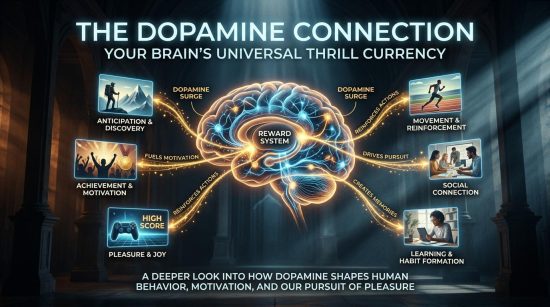
Have you ever wondered why your heart pounds the same way during a tense poker hand and a jump scare in a horror movie? That racing pulse, the sweaty palms, the strange cocktail of dread and excitement – it feels almost identical. And here’s the kicker: your brain can’t really tell the difference. The neurochemical response driving both experiences draws from the same deep well of anticipation, uncertainty, and reward. So let’s pull back the curtain on why high stakes and high fear are, at their core, two sides of a remarkably similar coin.
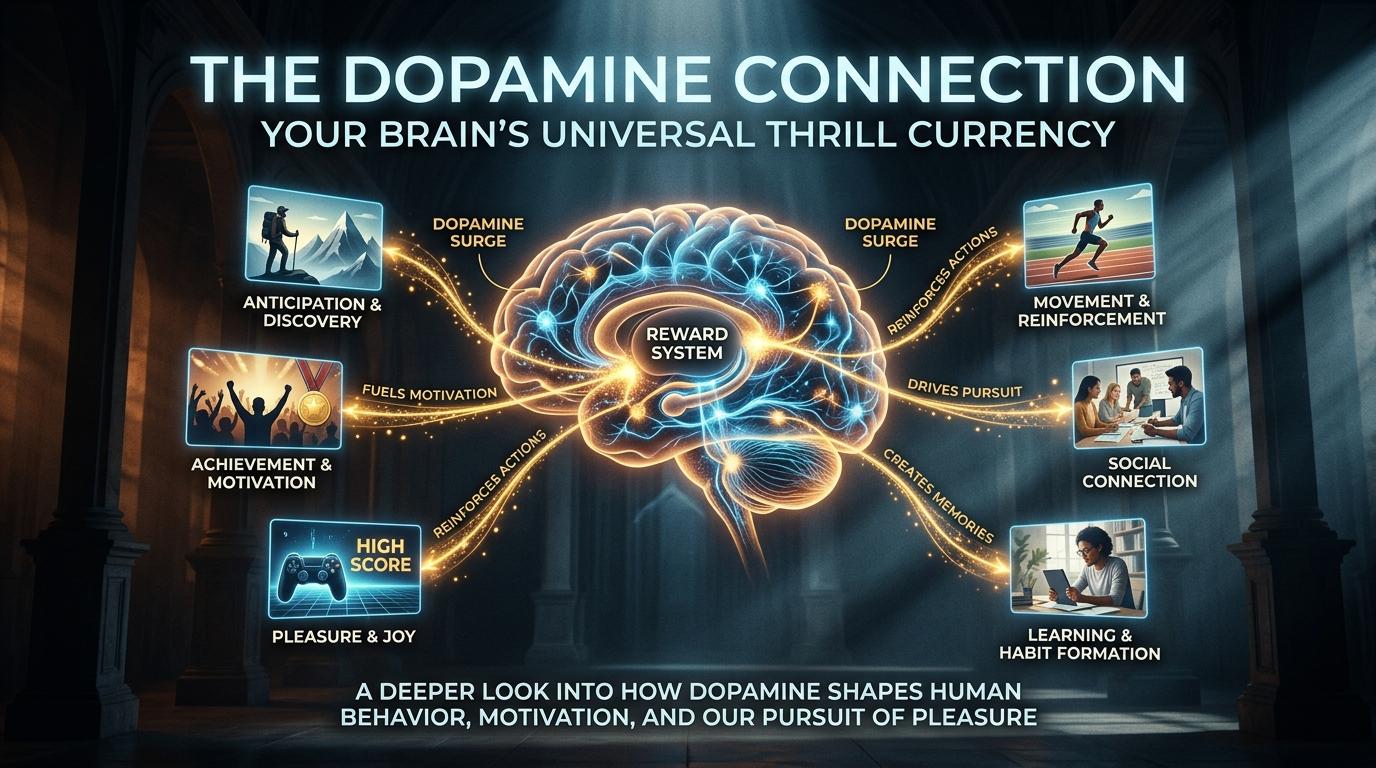
The Dopamine Connection – Your Brain’s Universal Thrill Currency
Why Uncertainty Is the Real Drug
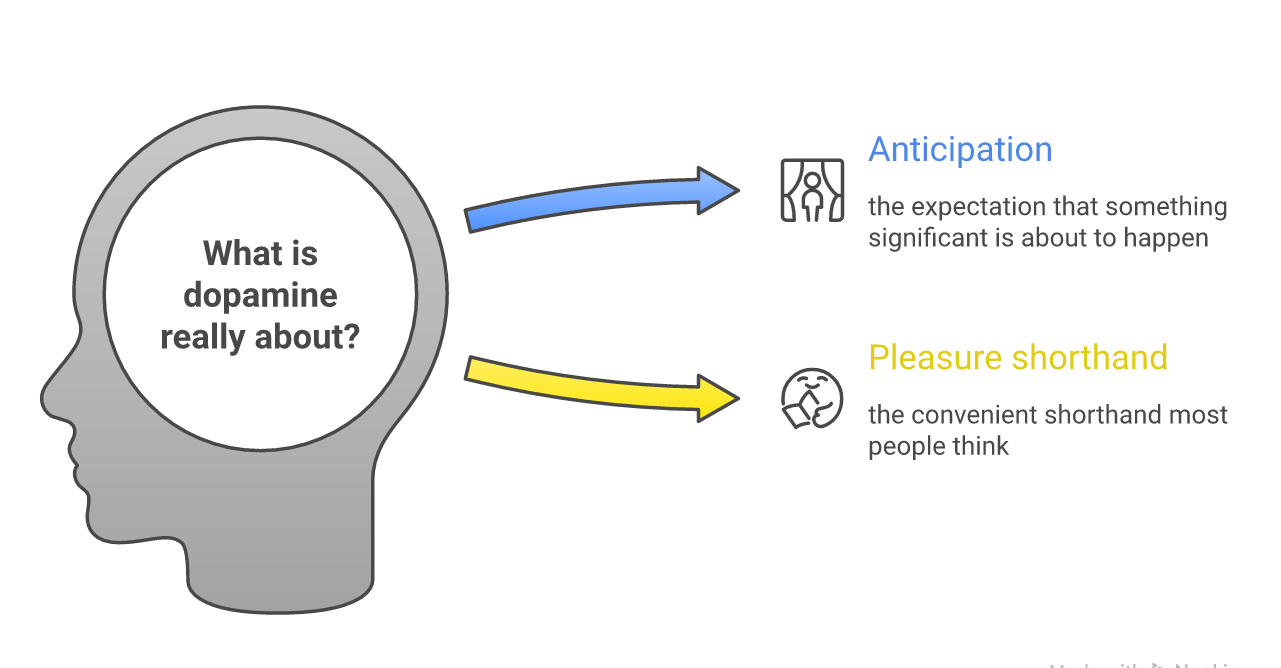
Most people think dopamine is simply the “pleasure chemical.” That’s a convenient shorthand, but it misses the bigger picture entirely. Dopamine is really about anticipation – the expectation that something significant is about to happen, whether good or terrifying. According to the Centre for Brain Health, dopamine activity rises most dramatically when rewards are random and unpredictable, and the system can be activated simply by placing a bet, regardless of whether you win or lose. Think about that for a moment. Your brain doesn’t need the payoff. It needs the possibility.
Horror works on an eerily similar principle. When you’re watching a character creep down a dark hallway, you don’t know when the scare is coming. That uncertainty – will the monster jump out now, or three seconds from now, or not at all – is precisely what floods your reward circuits with dopamine. As Kennesaw State University researchers have pointed out, fear can be genuinely pleasurable for many people, and dopamine is the mechanism that makes thrilling experiences feel worth repeating. So whether you’re spinning a roulette wheel or gripping the armrest during a horror film, your brain is essentially running the same program. This parallel even extends to how modern online casino platforms are structured, with some operators — such as those catalogued at https://automatenspielex.com/en/online-casinos/no-wagering-casinos — designing transparent bonus systems that strip away the layered uncertainty of complex wagering requirements, essentially isolating the core dopamine trigger of the game itself rather than burying it under additional conditions.
The Role of Anticipation in Reward Circuits
Here’s where things get especially interesting. A 2026 explainer from Chapter One notes that gambling, or even just thinking about gambling, floods the brain’s reward system with dopamine while simultaneously reducing the brain’s focus on risk-related thinking. Your prefrontal cortex – the region responsible for rational evaluation and impulse control – essentially gets quieter. You become less concerned with consequences and more attuned to possibility. Horror does something analogous. When you’re immersed in a frightening scenario, your analytical brain takes a back seat to your emotional and instinctual responses. The amygdala fires up, adrenaline flows, and your body enters a heightened state of arousal that feels remarkably close to excitement.
This overlap isn’t a coincidence. Both gambling and horror are experiences built around not knowing what happens next. The human brain evolved to pay very close attention to uncertain outcomes because, thousands of years ago, uncertainty often meant danger. Today we’ve channeled that ancient wiring into entertainment – slot machines, haunted houses, online poker rooms, and horror streaming binges. The packaging changed. The brain chemistry didn’t.
Shared Mechanisms – How Fear and Wagering Hijack the Same Circuits
Near-Misses, Jump Scares, and the Art of Almost
One of the most powerful psychological tools in both gambling and horror is the near-miss. In gambling, a near-miss occurs when you almost win – two matching symbols on a slot machine with the third just one position off, for instance. According to a 2026 Family Council report citing psychiatrists and neuropsychologists, online gambling platforms deliberately engineer instant rewards and near-misses to trigger “the same brain chemistry as other addictions.” Your brain interprets a near-miss almost like an actual win, keeping you engaged and chasing the next spin.
Horror uses a parallel technique brilliantly. The false scare – a cat jumping out of a closet instead of the killer, a door creaking open to reveal nothing – is the genre’s version of the near-miss. It builds tension without delivering the full payoff, which paradoxically makes you more invested. You lean in closer. Your dopamine system stays primed. When the real scare finally arrives, the release is that much more intense. Both industries have, whether consciously or not, mastered the art of keeping your reward system perpetually on edge.
The Neurochemical Cocktail Beyond Dopamine
Dopamine gets most of the headlines, but it doesn’t work alone. Norepinephrine – the chemical behind your fight-or-flight response – surges during both gambling and horror experiences. Cortisol, the stress hormone, rises too. Together, these chemicals create a state of heightened arousal that the brain can interpret as either terrifying or thrilling depending on context. In a safe environment like a movie theater or a regulated online casino, most people experience this arousal as excitement. The danger feels real enough to be stimulating but controlled enough to be enjoyable.
Here are the key neurochemical parallels that 2026 research has identified between horror and gambling experiences:
- Dopamine surges during uncertain outcomes, whether you’re awaiting a card flip or a jump scare
- The prefrontal cortex shows reduced activity during both gambling engagement and high-fear immersion, lowering rational risk assessment
- Near-miss effects in gambling and false scares in horror both sustain dopamine priming without delivering full resolution
- Problem gambling is linked to heightened craving-related brain activity when exposed to gambling cues, mirroring how horror fans seek out fear-inducing stimuli
- Structural differences in the striatum and prefrontal cortex have been associated with gambling disorders, suggesting these shared circuits can be physically altered by repeated high-arousal engagement
- Younger and more impulsive individuals are flagged as especially vulnerable to dopamine-driven override, since their prefrontal cortex is still developing
- Therapists confirm that gambling, gaming, and high-intensity digital entertainment all “hit that same spot of that dopamine reward system,” as noted by therapist Matt Missal in a 2026 Penn Live interview
The Convergence in Entertainment Design
How Products Are Engineered for Maximum Arousal
The entertainment industry has caught on. Certainly, game designers and platform developers are well aware that unpredictable, high-arousal rewards keep users engaged – whether the product is a horror video game with loot boxes or a slot machine with cinematic themes. The trend in 2026, broadly speaking, is convergence. Horror-themed slot games have been around for years, but the sophistication of how these products manipulate brain chemistry has reached new levels. Every flickering light, every suspenseful audio cue, every randomized reward schedule is calibrated to exploit the same dopamine-driven anticipation loop.
This isn’t just speculation. Research into the psychology behind online casino game design confirms that irregular, unpredictable rewards are a major driver of addictive gambling behavior. Meanwhile, the horror genre has long understood that unpredictability is what makes fear compelling. Combine the two, and you get a product that is, from a neurochemical standpoint, doubly potent.
| Feature | Gambling Experience | Horror Experience |
| Primary trigger | Uncertain financial outcome | Uncertain threat or scare timing |
| Key neurotransmitter | Dopamine (anticipation/reward) | Dopamine (anticipation/arousal) |
| Engagement technique | Near-misses and random rewards | False scares and tension building |
| Prefrontal cortex effect | Reduced risk evaluation | Reduced rational analysis |
| Physical response | Elevated heart rate, sweating | Elevated heart rate, sweating |
Regulatory Responses and Player Protection
Regulators aren’t ignoring these parallels. The trend across 2026 has been unmistakably toward tighter oversight of anything designed to exploit dopamine reward loops. From May 1, 2026, several jurisdictions have prohibited online gambling licensees from allowing or financing gambling with credit, a direct attempt to reduce impulsive, dopamine-fueled decision-making. Vizio’s 2026 predictions report highlights that player-protection systems are becoming mandatory and data-driven, centered on early risk detection, personalized interventions, and behavioral markers of harm.
Importantly, regulators are now prioritizing enforcement over market expansion. According to CMS’s 2026 expert guide on gambling laws, stricter licensing requirements, tighter advertising limits, stronger sanctions, and more aggressive blocking of unlicensed operators are becoming the norm across Central and Eastern Europe and beyond. The industry is also accelerating its adoption of AI-driven, real-time risk detection tools – not as optional features, but as default infrastructure. Why does this matter for our topic? Because the same brain chemistry that makes gambling thrilling also makes it potentially harmful, and the regulatory world is finally treating the neurochemistry seriously.
What This Means for You as a Player or a Fan
Enjoying the Thrill Responsibly
Understanding the brain chemistry behind your entertainment choices isn’t meant to scare you away from either horror or gambling. Quite the opposite, actually. When you recognize that your racing heart during a high-stakes blackjack hand comes from the same neurochemical cascade as a terrifying movie scene, you gain something valuable – perspective. You can enjoy the thrill while staying aware that your brain is being expertly manipulated by uncertainty and anticipation.
For gambling specifically, this awareness is a genuine tool for self-protection. If you notice yourself chasing losses or feeling compelled to keep playing after a string of near-misses, that’s your dopamine system talking, not your rational mind. The prefrontal cortex – your internal voice of reason – is being overridden. Recognizing the pattern is the first step toward maintaining control. As Recovery Diaries explains, this same addictive brain chemistry is what makes gambling feel so compulsive for vulnerable individuals. For horror fans, the stakes are obviously lower, but the principle holds: your brain craves the unpredictable, and content creators know exactly how to deliver it.
The Bigger Picture
No 2026 study has directly compared horror and gambling in a single controlled experiment. That’s worth acknowledging honestly. However, converging neuroscience evidence from clinical, academic, and regulatory sources consistently identifies the same reward-system mechanisms operating in both domains. The dopamine-driven anticipation loop, the arousal under uncertainty, the near-miss reinforcement – these aren’t metaphors. They’re measurable, observable brain processes that show up whether you’re pulling a lever or watching someone open a creaking door in a dark house.
Indeed, the “dopamine reward loop” framing has now gone mainstream in policy and public discourse. Therapists, regulators, and researchers routinely describe gambling and high-intensity digital entertainment as engaging identical circuitry. Research into the psychology of fear in controlled environments further supports this, demonstrating that the brain processes pleasurable fear through the same reward pathways activated during gambling. This matters because it shapes how we design products, how we regulate industries, and how we protect vulnerable populations – particularly younger users whose impulse-control systems are still maturing.
So the next time your pulse quickens at a casino table or during a late-night horror marathon, remember: your brain is running the same ancient software. The thrill of the unknown is hardwired into us. Enjoy it, respect it, and above all – understand it. That knowledge is the best bet you’ll ever make.