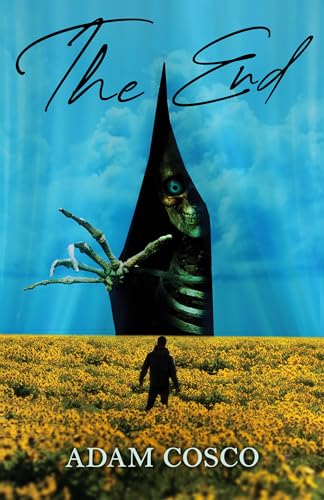
 Adam Cosco’s The End is a quietly devastating work of speculative fiction that blends intimate human grief with an unsettling meditation on technology, memory, and the stories we tell ourselves to survive. Part literary thriller, part philosophical sci-fi, the novel unfolds with an eerie patience that rewards close attention and emotional investment.
The opening section situates readers in a snowbound mountain town, where Eli and Selene arrive seeking a reset from the frictions of their Los Angeles life. Cosco’s prose here is restrained and atmospheric, favoring texture and mood over exposition. The frozen lake, the isolated cabin, and the soft rituals of shared silence create a fragile calm that feels deliberately temporary. This section excels at capturing the subtle disintegration of intimacy—how love can persist even as understanding slips away.
When Selene vanishes, the novel pivots sharply from melancholy realism into existential horror. The discovery of her fate—revealed through a time-lapse camera that becomes a silent witness—is chilling not because of graphic detail, but because of its emotional inevitability. Cosco understands that the most terrifying moments are those we cannot change, only replay. Grief in The End is not loud or performative; it is recursive, obsessive, and punishing.
The novel’s second half expands into speculative territory, tracing Eli’s immersion into immersive AI systems and simulated realities. Here, Cosco raises urgent questions about authorship, consent, and the commodification of human identity. The artificial intelligence modeled after Selene is not presented as a simple villain or miracle, but as something far more disturbing: a mirror that reflects how easily love can become possession, and how memory can be weaponized against healing.
What makes The End particularly compelling is its refusal to offer easy answers. Cosco avoids the common sci-fi trap of framing technology as either salvation or doom. Instead, AI becomes an extension of human desire—the need to preserve, to control, to rewrite loss into something tolerable. The horror is not that machines become too human, but that they inherit our unresolved grief.
Stylistically, the novel is confident and cinematic, with moments of striking visual clarity balanced by introspective depth. The prose occasionally fractures—intentionally mirroring Eli’s psychological state—and while this may challenge some readers, it ultimately reinforces the novel’s themes of fragmentation and unreliability.
The End is not a comforting book, nor does it aspire to be. It is a meditation on endings that do not feel finished, on love that outlives the body, and on the ethical boundaries we cross when we mistake remembrance for resurrection. Adam Cosco has written a haunting, timely novel that lingers long after the final page, asking not what technology will become—but what we are willing to become alongside it.