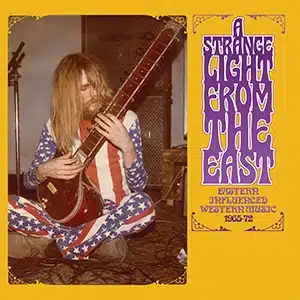

A Strange Light From the East: Eastern Influenced Western Music 1965-72
Various Artists
Cherry Red
21 August 2026
In their 2019 article on “raga rock”, Brian Ireland and Sharif Gemie point to several specific social and political phenomena as key to the surge in purported Asian influences on music in the 1960s Anglophone North Atlantic. They cite disillusionment with notions of Western civilization, manifest destiny, and Protestant institutions as one factor. Proxy wars in Vietnam and elsewhere in Asia, they argue, both contributed to this and foregrounded notions of the East in the Western imagination. In the United Kingdom, large local South Asian communities meant more on-the-ground contact between musicians of different backgrounds. In the United States, where such contact was less accessible to most white people, the struggles leading to India’s relatively recent independence resonated with the contemporary US Civil Rights Movement.
From the confluence of these and amid the upheaval of the early Cold War emerged a new iteration of orientalism for the so-called First World. In many ways, it resembled other such waves, imagining the East as exotic, erotic, spiritually heightened (i.e., psychedelic), and generally providing a countercultural contrast to the imagined West. On the other hand, continue Ireland and Gemie, this specific movement was distinct in that it “formed a platform from which to challenge dominant cultural and even political norms within the West; it was… rooted in a belief that embracing the music, culture and religions of the ‘East’ could help achieve a deeper knowledge of the human experience” (2019, 59). In other words, European and American musicians’ intent in engaging with Eastern ideas and influences was often sincere, even if the impact bears closer scrutiny.
These are some of the broad cultural strokes and questions at the foundation of A Strange Light from the East: Eastern Influenced Western Music 1965-72, a new and sizable compilation out on Cherry Red Records’ Strawberry imprint. Over three CDs, Strange Light explores many permutations of mostly English and U.S. American folk, rock, and pop laced with modes, rhythms, and philosophies derived, rightly or not, from their encounters with Easternness. The music that emerges is often beautiful, sometimes questionable, and always worth reflection.
Right at the start, we face an intriguing curatorial proposition: Bert Jansch‘s sparkling rendition of Davy Graham’s “Anji”. By finding the roots of alleged Eastern influences in Jansch’s bluesy fingerpicking folk, Strange Light establishes the stylistic foundations of alternate tuning and nimble acoustic melodies that would make clear affinities between the sonic worlds at hand. This is a fascinating choice by the production team, especially thought-provoking as we move from crystal clarity into the fuzz of the Yardbirds’ “Heart Full of Soul” and the Byrds‘ “Eight Miles High”.
From there, we move, bouncing across space and forward through time, soaking in how these musicians channeled their impressions of India and elsewhere in Asia for Euro-American audiences. Listening from the vantage point of 2026, of course, it’s easy to point out some of the problems with these impressions. The blending of sitar with hallucinatory imagery of “a place with mountains edged with lace / A place where we can find jellybeans and wine” in Spencer Davis Group’s “After Tea” serves as an uncomfortable reminder of the connection between orientalism and psych rock.
West Coast Pop Art Experimental Band’s “Buddha” depicts the devotional figure as “so beautiful and naïve / With bells on” in earnest but worrisome oversimplification. However, Strange Light has many complex dimensions, especially as we reach the 1970s on disc three. Ananda Shankar’s plugged-in cover of “Jumpin’ Jack Flash”, Nitai Dasgupta’s entrancing “Baitha Tano”, and Pandit Kanwar Sain Trikha’s “Folk Piece in Kahrwa” (all songs by artists based in London) remind us that crossovers and encounters always involve more than one agentive being, and that innovation takes place in many directions.
The mostly North Atlantic-based sitar pop and raga rock of the 1960s and 1970s have become aurally synonymous with Summer of Love culture and the Hippie Trail, and that is not neutral. It bespeaks long-held notions of difference between East and West that have been mobilized to alienating, appropriative, and violent ends.
Yet, as I listen to this album, I think there is indeed something to Ireland and Gemie’s analysis, from which they conclude that “the ‘turn to the East’ [was] something arguably more substantial than other musical fashions: it is difficult to think of other movements which had similar musical, spiritual, philosophical and artistic dimensions” (2019, 94). This comes through on the songs selected here. Alongside the well-meaning ignorance that marks some of the lyrics and treatments of Indian and other Asian cultures, there is also deep thought and emotion about music and personhood. This compilation features the mellifluous sounds of people genuinely trying to open up their minds and worlds and share with one another, and whether they succeed or not,A Strange Light from the East chronicles it well.
Work Cited
Ireland, Brian, and Sharif Gemie. 2019. “Raga Rock: Popular Music and the Turn to the East in the 1960s“. Journal of American Studies 53, no. 1: 57-94.