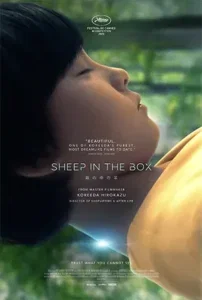

Sheep in the Box
Hirokazu Koreeda
Neon | Picturehouse
24 July 2026 (US) | 14 August 2026 (Edinburgh)
Sci-fi fantasy Sheep in the Box follows Otone (Haruka Ayase) and Kensuke (Daigo Yamamoto), a grieving couple who lost their seven-year-old son, Kakeru (Kuwaki Rimu), in an accident and, two years later, still cannot move on. Director Hirokazu Koreeda normalizes a strange relationship between human and android in an excessively naive way, treating parent-child bonds as if they were merely the result of learning and behavioral mimicry.
A drone delivers to the family, among its routine packages, an advertisement for a humanoid android meant to ease the pain of their loss. A robotic stork carries with it the promise of gestation and conception for the being to come. Sheep in the Box presents the scene in such a way that the entire procedure feels palatable, almost as if acquiring an artificial substitute for a dead child were just another possible stage of grief.
The effect is to present human-machine integration as a legitimate therapeutic possibility, markedly diminishing the ethical ambivalence involved. The procedure shown on screen is less innocent: we use the memories and photos of a deceased loved one, choose the age and level of intelligence, and have the final result delivered to our doorstep. In this way, part of the suffering seems avoidable for those who “integrate glass and wood”, as Otone will later tell her artificial son while explaining the difficulties she faces in designing a house that tries to preserve a natural connection with the trees amid a technological landscape.
This idea also appears in the comparison between the parents’ professions and their relationships with the little tin-head. Otone, the mother, is an architect who takes on complex projects, tries to integrate natural solutions, and has an affection for trees — she planted a lemon tree in the backyard in memory of her deceased son, and it is now becoming lush. Kensuke, the father, is a carpenter who works at a company run by an old craftsman, who instructs him to hold scraps of wood to his ear so that he can hear what kind of object they will become. Trees have souls, he says, and we need to make use of every last piece of those we kill for our craft.
Here, it becomes clear that the android begins to adapt and reproduce small preferences based on the parents’ art and philosophy, and what they show him: he becomes interested in plants and trees, likes building blocks, memorizes different types of wood, and, in a caricatural way, mimics the gesture of holding little pieces of wood to his ear. For the characters around them, that is enough as confirmation: he learned from you; therefore, he is your son!
Indeed, he inherited his parents’ will and aptitude. The little robot even repeats his mother’s mantra — “that’s why I love architecture” — while trying to design a treehouse. This expands on the earlier idea of big data’s total benignity. The same people who, within the film, desperately attribute personality to the robot boy are, in our world, the users who anthropomorphize AI systems and begin to attribute affection and identity to responses shaped by the interaction itself.
Kuwaki Rimu, the young actor, conveys discomfort through a performance full of blank, lost looks, at least for the first half of Sheep in the Box. The role allows small imprecisions in the performance — especially the misplaced smiles at the beginning of some serious or sad exchanges — to lend the character a sense of strangeness. The detail matters because he is a machine trying to adapt to context, and what Koreeda intends as sweetness and innocence ends up producing a certain discomfort: the robot wakes up in the middle of the night in his charging module, his “little stool”, already smiling and staring into the dark room. Yikes.
Yamamoto is the standout. He plays a deeply believable, exhausted character who gives in to his wife’s request despite being disturbed by the situation: now he has a robot with a face like his dead son’s walking around the house, asking what he is eating, what the drawing on the wall is, and which train lines the real child used to like memorizing. Torn by the pain and guilt of his loss, he conveys through his gaze the journey toward an inevitable attachment to the robot and the pain of accepting that his son is truly gone; his character relies on anguished pauses between sips of beer while talking to the machine in the first few formative days.
The camera repeatedly tries to show how bright the future is, opening the frame to the treetops and the golden glow of sunlight filtering through the branches. The feeling is one of constant reassurance, reinforced by the happy and almost puerile soundtrack, filled with string instruments, mainly the cello, in major-key, harmonically consonant melodic lines. It is almost an extension of a Disney fairy tale: the message is one of complete confidence, that everything will work itself out without major conflict.
Cuts reinforce this dynamic, moving from a poorly lit tunnel at night into the light of dawn outside. Much of the action takes place during the day, ensuring abundant sunlight and mitigating ambiguity in the characters’ nature. The contrast reinforces the impression of transparency and comfort that dominates the film’s vision of this future.
Sheep in the Box works best when it portrays how the suffering of loss can last longer than expected. That is where it captures something real: how loss affects an entire family and shapes who we are, especially parents after the death of a child. It loses strength when it compares relationships of learning and affection to bonds of parenthood, even when those bonds are not based on blood.
At first,Sheep in the Boxseemed like a film about accepting and overcoming trauma and grief, but by the end, it comes to signify a failed attempt to humanize the artificialization of parental relationships and to transform our desire to escape pain into a promise of healing.