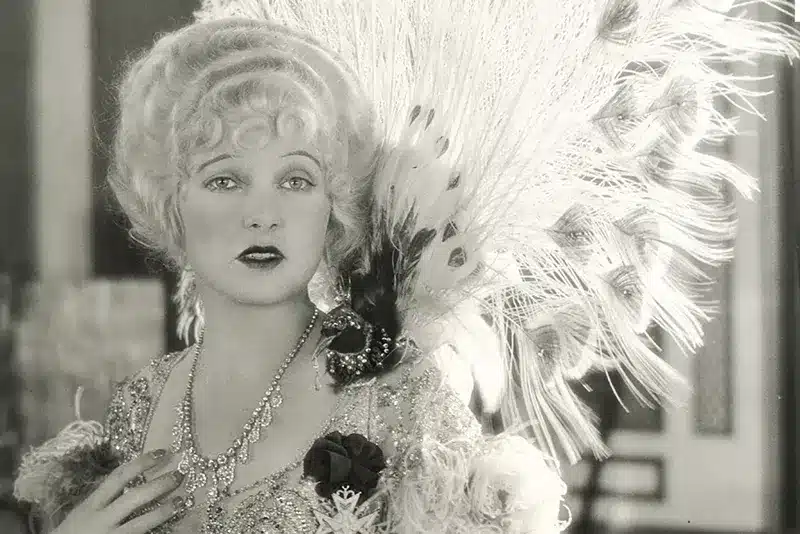
Corinne Griffith was one of Hollywood’s biggest names in the silent era. She was routinely hailed as one of the screen’s most beautiful stars and incidentally one of its most financially astute. While many of her colleagues floundered in their forced retirement when the talkies arrived, Griffith just got richer and richer, investing in real estate, and died a very wealthy woman.
Silent film buffs can rediscover her skill and charm in Lewis Milestone‘s comedy The Garden of Eden (1928). The film is freshly restored by San Francisco Film Preserve and issued on Blu-ray by Flicker Alley with an original score by Stephen Horne and Frank Bockius.
The Garden of Eden’s story begins with ingenue Toni (Griffith) running away from her parents’ pretzel shop in Vienna at night after receiving an invitation to pursue her singing career in Budapest. Since she wants to sing opera and Vienna is famous for exactly that, she might have stayed where she was, but we won’t pick holes already. Clearly, she wants to get away from the folks.
The invitation in Budapest turns out to be from a seedy nightclub where dancing girls show off their legs. Toni learns this when meeting the proprietor, one Madame Bauer (Maude George), with perhaps an undue emphasis on the “madame”. She’s very mannish, which is code for butch, which is code for something else. Madame practically purveys the naïve Toni to a rich, slick playboy called Henri d’Avril. He’s played by Lowell Sherman, who specialized in portraying cads when he wasn’t directing films himself.
Toni turns feisty and gets fired along with the middle-aged wardrobe mistress, Rose (Louise Dresser). All this is mere setup that will get us toThe Garden of Eden, an attraction in a Monte Carlo hotel. For the first whopper, we must believe in this lighter-than-air tale: that Rosa is really an impoverished baroness who splurges in Monte Carlo once a year when her late husband’s pension comes in. She takes Toni with her as her alleged daughter.
In Monte Carlo, Toni suffers the kind of troubles that should happen to all of us, and they center on the attentions of a supposedly charming young songwriter named Richard Dupont. He’s played by Charles Ray, a Hollywood casualty at the tail end of his stardom. Ray replaced Douglas Fairbanks Jr. during the troubled and protracted production. While Fairbanks would surely have been better, Ray has the accidental advantage of resembling the rather baby-faced Sherman, and the plot of The Garden of Eden will account for why that’s so.
Abetted by the lavish production design of William Cameron Menzies, Milestone’s direction is excellently visual, one of his hallmarks as a director. He elegantly conveys the script’s many saucy touches, which usually involve women putting on or taking off their clothes and sometimes parading in their slips.
If these winking moments have something in common with the films of Ernst Lubitsch, they come by it honestly, as scriptwriter Hanns Kräly was Lubitsch’s frequent collaborator. The story derives from an Austrian play that was adapted into a Broadway production by Avery Hopwood, a highly popular “playboy” playwright who died in 1928.
Milestone directed several silent films but is best known for his talkies. His most famous film is All Quiet on the Western Front (1930), for which he secured one of his two Oscars, and his last two productions were Ocean’s 11 (1960) and Mutiny on the Bounty (1962). That’s a career.
When released in theatres, The Garden of Eden had a brief Technicolor sequence. Alas, that’s been lost except for a few stills. This restoration uses stills as a substitute reconstruction, and viewers can choose to integrate the segment into the film or watch it as a bonus. An essay on Griffith’s career is another good bonus from Flicker Alley. The commentary by Milestone biographer Harlow Robinson discusses the background of a film that was so over-budget that, despite being popular with audiences, it still lost money.
The Garden of Eden was Griffith’s only independent release through United Artists. As we’ve stated, she was extremely popular and made many films, mostly for First National. At the height of her fame, she ran her own production company. She was nominated for an Oscar as Lady Hamilton in Frank Lloyd’s The Divine Lady (1929). Sadly, the lion’s share of her films is lost. For example, a bonus on the Blu-ray is the only existing fragment of Richard Wallace’s Syncopating Sue (1926).
We hope more restorations of Corinne Griffith’s films will surface. A great choice would be Lloyd’s Black Oxen (1923), a huge hit based on Gertrude Atherton’s quasi-science-fictional bestseller about an artificially rejuvenated woman. Future star Clara Bow had an early supporting part in that one. For now, Flicker Alley’s The Garden of Eden must satisfy our craving for the silent era’s forbidden fruits.