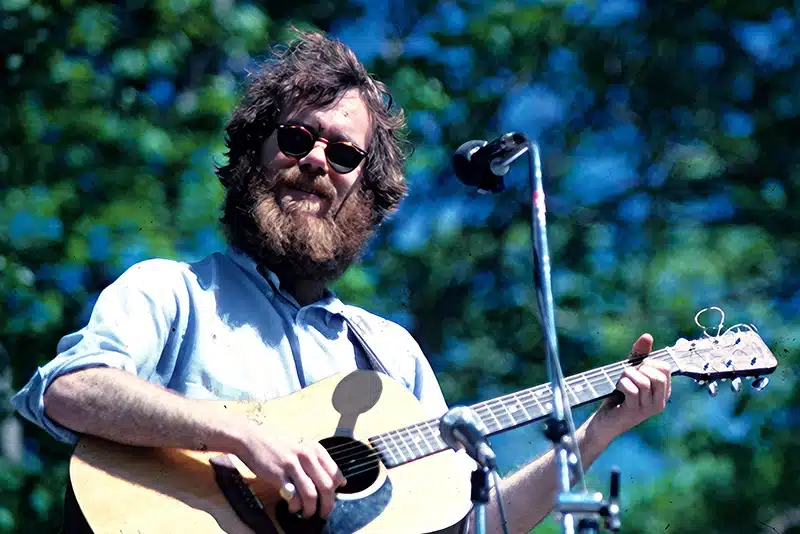
“What the fuck,” Loudon Wainwright told the audience at his birthday tribute concert. The singer-songwriter had turned 80 on 5th September. A week later, fans, friends, family members, fellow artists, and (morbid?) curiosity seekers had assembled at the Midtown Manhattan venue Town Hall—itself over 100 years old—to celebrate the milestone by performing Wainwright’s combinations of folk, country, and pop-rock.
The event began with Wainwright delivering a few of his overtly autobiographical songs. For example, “Westchester County”—from 1983’s sardonically titled Fame and Wealth—forthrightly describes his comfortable upbringing in tony suburbs north of New York City. Over three hours later, the closer was a full-cast singalong to Wainwright’s one hit single, the 1972 novelty “Dead Skunk”.
Very close to the end of the night, Wainwright explained that he’d wondered if he could write a new song for the occasion. WTF—as he put it, though without the acronym—he proved able to write one, and the people in Town Hall were the first to hear it. Wainwright’s announcement and the song perfectly represented the performer and his patented life-as-art-and-vice-versa.
Perhaps not everyone, perhaps especially in a largely gray-to-white-haired crowd, expects to be treated to the F-word so casually in such an auspicious setting. Wainwright has never observed such proprieties. He has said that there’ll always be a moment when he makes you uncomfortable. Take him—as an artist and seemingly as a companion, a collaborator, a relative—for what he is, as he has chosen to present himself since releasing his first album, 1970’s Loudon Wainwright III. Otherwise, leave him to his always interesting career moves, which have included early appearances in the TV show M*A*S*H and contributions of topical songs to National Public Radio.
Wainwright’s new song, delivered a cappella with lyrics read from a teleprompter he made no secret of, focused on touch. The octogenarian began with his infancy, describing his mother’s touch and, less frequently, his father’s. He moved straight to touching himself, at night and “in broad daylight”, during adolescence.
A verse about the Beatles‘ “I Want to Hold Your Hand”, which he probably first heard around age 18, grouped new kinds of touching, including Wainwright’s being gripped by music. In the end, he returned to those formative parental touches. As a portrait of the artist as a reflective man, the song distilled most of this performer’s signature attributes: an unexpected angle, articulate lyrics, humor, shocking frankness with a dose of self-laceration, and an ultimately touching—pun entirely intended—emotional appeal.
Those qualities imbued every performance in the tribute, which combined professional skill and homespun, sometimes ramshackle charm. Each artist—from longtime accompanists such as Chaim Tannenbaum to surprises such as Nellie McKay—seemed free to be as wonderful or weird as they wanted, with one restriction: no one was to upstage the birthday boy. Wainwright remains, as he famously declared in a 1985 song, “a one-man guy… a one-man show”.
The concert had been billed as starring friends and family members, but over the hours it became clear that Loudon Wainwright was not going to sit back and watch other people perform his songs. The evening turned into a Loudon Wainwright tribute starring Loudon Wainwright, and as such it delivered a fascinatingly complicated, hugely entertaining picture.
Longtime followers of Wainwright know how fraught his relationships have been with at least his two eldest children, the singer-songwriters Rufus and Martha. Verbal and physical interactions in the spotlight made clear that old wounds on all sides haven’t healed entirely or at least have left scars. The music brings the extended family members together, and the results generally prove glorious. The dramatic messiness of human life keeps the music from ever lapsing into sweetness.
The evening’s emcee, filmmaker Judd Apatow, who employed Wainwright as soundtrack composer and actor in his comedyKnocked Up(2007), delivered a tongue-in-cheek case for Wainwright’s having surpassed his one-time influence, Bob Dylan. The comparison has been around since Wainwright first started performing, but it mainly highlights how the two men differ. Still, if a body of work needs to be compared to Dylan’s, Loudon Wainwright’s inventive examinations of life’s small pleasures and big pains can hold their own.