Oregon has a rich history of excluding Black people. During westward expansion, while whites were incentivized to “settle” the inchoate Oregon through the “Donation Land Claim Act,” Black people were prohibited from entering the territory. In 1859, Oregon became the 33rd state in the Union, and the only one admitted with an “exclusion clause”. Oregonians may have been anti-slavery, but the consequences of their ardent anti-Blackness continue to reverberate. Today, only 2% of Oregon is Black, and in 2016, its largest city, Portland, was labeled by the Atlantic, “the Whitest City in America”.
Now, when one hears the phrase, “Portland’s finest practitioners of Great Black Music,” it evokes a patchwork of thoughts, feelings, and disconnected images. It draws attention to Portland’s near-blinding whiteness, while suggesting a rupture in its exclusionary legacy. Placing “Great Black Music”, a nod to the legendary avant-garde jazz group the Art Ensemble of Chicago, beside the qualifier “Portland” has the effect of assemblage art. Arthur Jafa quotes filmmaker John Akomfrah saying, “What we’re trying to do is put a series of things into some sort of affective proximity to one another.” Putting things, whether words, ideas, or resonances, in an “affective proximity to one another” is whatthe Cosmic Tones Research Trio, “Portland’s finest practitioners of Great Black Music”, do best.
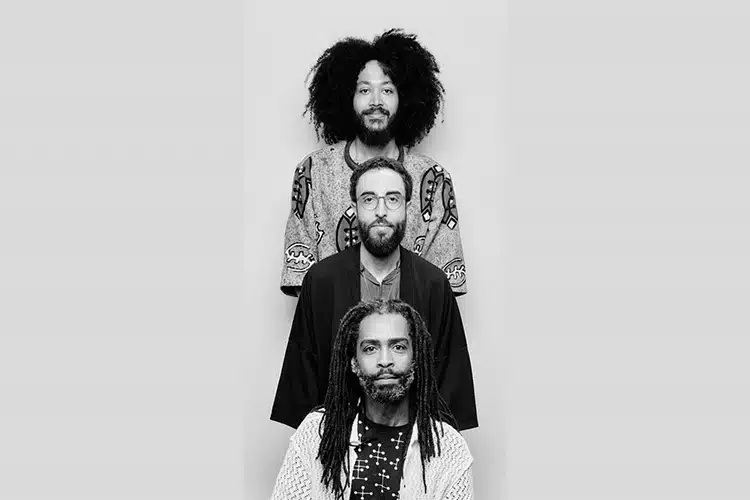
Like many of the most compelling ensembles, the members of the Cosmic Tones Research Trio, Roman Norfleet, Harlan Silverman, and Kennedy Verrett, support one another’s musical perspective while offering their own singular points of view. The strength of each member’s distinctive approach is evident in their solo and other collaborative work, such as Silverman’s recently released Music for Stillness and Norfleet’s forthcoming album with Andre Raiah, The MerKaBa Brotherhood. Still, the Cosmic Tones Research Trio’s captivating convergence on All Is Sound and their follow-up self-titled album embody a distinct alchemy.
I had the pleasure of speaking with them about their diverse musical backgrounds, spiritual practices, political preoccupations, and, of course, the research behind their markedly cosmic tones.
How did you all arrive in Portland?
Roman: What brought me to Portland is the shifting of time, the shifting of energy. I was in Los Angeles for about nine years, and then the pandemic hit, and I had to shift to a new location. I moved with my partner to Virginia. That season went past, and I needed to go somewhere else. I had a friend who was moving out here to Oregon, and she invited me to come with her. I had moved with her various times before, so I trusted the invitation and came. I didn’t know anything about Oregon, Portland. I just landed. I moved here at the end of 2020.
Harlan: I moved in 2020 as well, from LA to Portland. I was born in New York, but I grew up in LA. I moved to LA when I was five, so I’m definitely more West Coast. I wanted to be in a different environment, in nature. I had been in the studio world for a long time, and I wanted to get outside of it. I was up here during the pandemic, and my partner is from Oregon, so we made the move.
Kennedy: I came from the mountains in Southern California. Before that, I was in LA just doing the LA hustle, writing music, doing the things, but I was always outdoors as much as I could be. So, I was looking for a lift-and-shift. LA is such a bubble of hustle and go all the time. You feel this urge to be constantly producing and doing things, and at that point in my life, I was like, I need to breathe and chill out. So, with the partner I had at the time, we were observing all the places we could possibly be, and ended up here largely because of the nature and slower pace.
That was the summer of 2018. Then COVID hit, and there was this transitional sort of vibe. So I was back and forth between here and the desert down in Joshua Tree, just trying to figure it out. Because I had just done a giant move, I didn’t want to move all my stuff again. So I planted hereand said,“All right, this is where I’ll perch at least, and use that as a hub to travel.” Then, a couple of years ago, I ran across these cats.
You refer to yourselves as practitioners of Great Black Music. But you also put a spin on it, calling yourselves “Portland’s finest practitioners of Great Black Music.” How did you arrive at that description of the music?
Roman: The “finest practitioners” part is not our words. That’s something that folks just put in there to put a little razzle-dazzle, butyes, Great Black Music is a nod to the ethos of what the Art Ensemble,AACM, and those beautiful folks in Chicago started. Not to necessarily connect us directly to that, we haven’t played with them or anything, but more so the lineage of Black music and sound and communal playing and improvisation. I love that term when it comes to describing the music, because it encompasses so, so much. So much music, so many people, so many regions. We were asked to provide a description and wording for our last few projects, and it just kind of stuck around.
What’s it like making Great Black Music in Portland?
Roman: The labeling of “Portland’s finest practitioners” was more from the label. We didn’t necessarily make our own stance of being like Portland’s spiritual jazz and Black folks. It’s just kind of organic because there aren’t a lot of Black people here. So I think this music has been very special for Portland. It may be something like a wind of change that may not have blown through here as strongly in some time. It seems that the community in Portland really feels this music. It seems to be something new for a lot of people here in Portland.
There have been so many great musicians and artists here who’ve made amazing music, and we stand on the shoulders of many. But I think this configuration and the combination of the three of us and the music we’re doing is something special and new to this landscape. That’s why so much emphasis is on us being from Portland, being Black, and making Black music here in Portland, because it’s not a diverse place, and we are three brothers making very special music here.
Can you walk me through the chronology of The Cosmic Tones Research Trio?
Harlan: There was this arson at Mississippi Records [the record store], and they wanted to have some music that would heal and cleanse the space. So that was the first time we came together. Roman had met Kennedy at a show, and Roman and I also met at a show. So we came together to play this one-off event. We didn’t think it was going to be a group, per se, but there was a real feeling that there’s a need for this kind of music, therapeutic, healing music, and in Portland, I think everywhere in the world, but really in Portland. So from there, I think that night, Eric [Isaacson] was like, “Hey, if you guys make a record, I’ll put it out.” So that really put the fire, like, “okay, well, let’s at least make a record.” From there, it just kept growing and growing.
And was that the performance recorded on the Be Present Art Group’s The Spiritual Sonic Research Series?
Harlan: Yeah, it’s pretty cool that the first time we ever played together is recorded.
Roman: What happened was someone threw a Molotov cocktail in the window. We released an album with Mississippi with Be Present Art Group, and that record was close to the wall that caught on fire. I remember walking in and seeing that, and I was like, whoa. It felt really close to home because we were making so much wonderful music and having a wonderful experience in community. So I came back and did a bunch of rituals at the store. Then it came to me that that wasn’t enough. It wasn’t enough protection for the store. So I played with these brothers.
It was the first time I actually played with them. I met them on different occasions, but this is a more in-depth version. I met Harlan at a jam. I met Kennedy at a jam. And the first time I played with them both together was at this Be Present Art group concert called Their Cowries. This was one of the first concerts we had multiple rehearsals for. Sometimes people would show up early, and so there would be a little improvisational fun and practice. I was peeping a lot of that, and I was like, yeah, jam with these two brothers. So when the store caught on fire and music came up as something that needed to be set as a protection spell, they were the first two I thought of because of all those prior experiences.
Do we have any idea why the arson attempt happened?
Roman: To my knowledge, it’s an unsolved mystery.
I saw your Brooklyn debut at Public Records and was struck by the difference between your live show and the record. How does your approach to composing and recording in the studio differ from your approach to live performance?
Harlan: Live is definitely more stretched out, more improv. The records are made so as not to wear out the music, so the listener can listen over and over and over. I’ve seen lots of comments say, “This album is really good, but it’s just too short. It should have been longer.” That’s on purpose, because people will keep listening to it, and you’ll keep revisiting it. On the records, there’s not a lot of improvisation; live is where you really get to see more of the improvisational element of the group.
How did you arrive at that clarity of approach?
Harlan: Part of it is just the nature of being on stage together leads to more improvisation than the record. I come from a record production world where the songs are beginning, middle, and end, and there’s nothing like ten-minute songs or those kinds of things you get in jazz records. I love jazz music. We all love jazz music, but we also love a lot of different styles of music that usually have shorter pieces. I think it’s more digestible. I think part of the thing that can be hard for people with jazz is when there’s a ten-minute song, and there’s four-minute solos on the record. Live, it’s a great thing to see because the audience is shaping the solos. As you saw, if there were no audience at Public Records, that concert would be completely different.
Harlan, you mixed and produced this most recent self-titled release, with additional production by Roman. What was your approach and intention for building and supporting the sonic world from a technical perspective?
Harlan: The studio is so much fun, so much sonic exploration. I think that’s also what we’re seeing in jazz music in this new era, where there’s a lot more studio techniques used. It’s not like RVG (Rudy Van Gelder) style: come in, bring in Miles Davis and Coltrane, put a mic in front of them, and get that masterpiece. Even with the straight-ahead guys, they’re interested in this studio gear. Reverb, delays, chorus, flange, all these different tools that are more thought of in the pop realm of music production or electronic music realm, dub, all that stuff. So it’s really a big part of the group’s sound that the instruments are augmented with studio tools.
You all employ a great diversity of instruments in your music. What inspires your choice of instrumentation?
Kennedy: It all boils down to timbre, the color, the quality, and how they blend. We’re not particularly restricting ourselves to any sounds. They’re all a part of the sonic vocabulary of The Cosmic Tones Research Trio. So that allows us a considerable amount of freedom in that all sounds that are available to us are absolutely relevant in telling the story and bearing witness to what it is that we’re trying to bring to people, and that’s breath. So the woodwinds, you have to breathe in order to be able to play those. And it’s such a meditative thing. Even with my piano students, I’m like, “take a breath, and then play the phrase”, because it allows your body to, automatically, set into place.
In the live setting, we’re able to match the energy of whatever is in the room, because there’s a call and then there’s a response. The only way you know you’re being listened to is by the response; that’s George Lewis from the AACM. In the studio setting, we’re responding to each other in real time as these pieces are evolving and becoming something that is organic and not just from the ether. That balance, coupled with our understanding of being out in the environment and listening to environmental sounds, research, culture, and history, is all embedded in the Cosmic Tones Research Trio sound.
When we talk about modular synths, it’s a vocabulary that is very prevalent today, but it also allows us to use electricity to shape a sonic reality that is not necessarily part of the jazz texture, which allows us to explore something very new and experimental, if you will, but also honoring the tradition of what came before, because brothers been doing this for a while. But in this unique trio setting, there’s a dynamic to it. There’s a breath to it. There’s that spiritual nature, which is at the forefront, and then that recognition that the forces that are actually happening are bigger than us, and we’re just there to facilitate it and bear witness.
Can you tell the story of the group’s name?
Roman: I had already been doing a lot of research and using that word before the fire. I do a lot of historical research, traveling to the south in particular, and going to historical sites, landmarks, grave sites, memorials, abandoned houses, as well as collecting archival artifacts, Black ephemera, and memorabilia. I started to incorporate a lot of that research into sonic form. I started to consider everything that I was doing as a kind of research to fuel the music and to gain more spiritual knowledge.
All of us research different things. We have very diverse ways of researching and learning that fuel our craft. So this research term was being used a lot. Then, when the fire came, it felt like another opportunity to use the realm and insignia, if you will, of research to propel music even further. Taking this experience, what can we learn from it? Why did it happen? Taking every facet of life as a moment of research, to fuel our greater good, to fuel more peace, to fuel positivity, to fuel what we need. It’s a way of looking at life. It’s a way of being.
Yeah, there was a nod to that Sun Ra album (Cosmic Tones for Mental Therapy) because he’s trying to explore how cosmic tones can be used to heal. Though he didn’t call it research, it is a form of research. Because research was already floating around, it was just a natural connection. It’s meshed between the album, the existing research we were all doing, and the fire. It melted together in that way. We’re all like scientists of sound. So it’s a natural, organic fit.
What have you all been researching most recently?
Roman: I’ve been researching the history of blackface in our country and, in particular, here in Oregon. I’m learning more and more that it was some sort of spell, it was some sort of ritual, and it was some sort of action to siphon power, to take energy, a being, a joy, a presence that another folk expressed organically, to embody it in a way that is foreign to the people who were putting on blackface. That is powerful because you’re not going to do all that to someone you absolutely despise.
They spent a lot of time coming up with these methods to look like Black people, coming up with dance routines, to dance like Black people, coming up with objects, plates, salt, and pepper shakers, all these things to siphon melanated energy. You can see with the music, with all the thieves like Elvis and the Beatles. I won’t call them all thieves. Some of them were brought on by Black people, but society at large would attribute all this music to white people. I’m studying blackface right now, but it’s all connected to music and the siphoning and stealing of Black imagery, sound, and culture in America.
I’m looking at it, yes, through race, the made-up concept and construct, but I’m looking at it and angling it from more of an esoteric and spiritual aspect. The Bible talks about, we don’t wrestle against flesh and blood, but against power and principalities [Ephesians 6:12]. So it’s kind of like that vibe, I’m leaving the material aspect of it and honing in on the true desire to take these images and to wear a whole other person’s skin on your face. That’s kind of what I’m studying right now.
Harlan: I’m always studying Buddhism. It has helped me spiritually, musically, in relationships, in every facet of my life. So, that’s the ongoing underlying study outside of music. In Japan, I discovered the esoteric school, and that really has a lot of ties to nature. So living in Oregon, I find a lot of parallels to the things that I was able to study and learn in Japan. Koyasan is where I went, and that’s the whole Shinto multiple temple city up in the mountains. Beautiful place. So special.
Kennedy: I’m always on a spiritual journey. A lot of my experimentation and research is about understanding how the spirit presents itself in the most subtle of ways, and how we can use the code that has been given to us, literally by nature, and has been extracted and coded into our music to affect all kinds of cool stuff. For example, I have this device, it’s called a Pocket Scion. The Scion is this piece of a plant that comes out, and it goes and sends sprouts all over the place. I can connect this [Pocket Scion] to a plant, and the bio frequency from that plant activates this synthesizer. I’m not necessarily hearing the plant, but I can hear what rhythms they’re throwing down.
I don’t know if you can see behind me, but this is a rack of Bourdon pipes from a pipe organ. I’m always fascinated by this organ because it’s just like going into a giant flute. That’s nine and a half feet, that pipe. I know if I cut that pipe in half, I get the octave. But these two pipes next to each other, the C and the C sharp, if I turn them on, I have to leave my apartment to actually hear the frequency, because when I’m standing next to it, all I feel are the waves fighting each other. What’s cool about that is if I bring somebody in here and they’re in need of an exorcism, I can make that happen with sound.
I know that if I bring them here and sit them on this couch and plug this thing in, there are certain frequencies found within the fundamental of just one of those pipes that I can then get all of those other pipes and tune them perfectly so that we can align them sonically. This is music therapy. We talk about chakras and all these magic frequencies. Those are frequencies that are fixed. But our natural frequency fluctuates with temperature, with how our environment is, how we’re actually reacting psychoacoustically to those sounds.
Once you realize that these things are occurring naturally and our body is receiving that, then you can effectively and intentionally move people emotionally, physically, and psychoacoustically. That’s an incredible responsibility that we have as creators and musicians.